

Process of religious conversions
Reviewed by Pooja Jha, Advocate on July 14, 2026The process of religious conversion was not a new phenomenon in India. The history of India was a colonial construct, written on the basis of three religious faiths in chronological order. The ancient represent rulers of Hindu, medieval era called as the Muslim rule and the modern era ruled by the British people which stand for the Christianity.
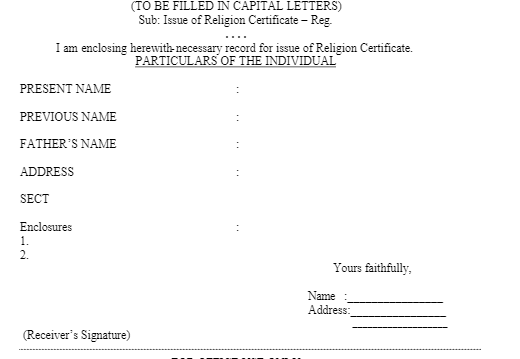
Process of changing your religion in India.
Right to religion is one of our fundamental rights. This is something which actually means that anybody can practice or profess any religion. This also means that you can change your religion at any time in your life. There could be many reasons, of course. eg: Someone wants to follow different faith or sometimes people might be getting married to somebody of a different religion.
To change your religion in India, the first and foremost important step is obtaining a conversion certificate. Each religion prescribes a different process of obtaining a conversion certificate. For example, if you want to convert to Islam, you need to approach a mosque in your area. They will then perform certain religious rites and the maulvi will give you a certificate. Similarly, if you want to convert to Hinduism, you can approach the nearest temple, and after performing certain religious activities, the priest will give you a certificate.
Well, after obtaining these certificate, you need to remember that this is not the only thing which is required for changing your religion. The next step is approaching the gazette of india for declaring your change of religion ( The Gazette of India is a public journal and an authorised legal document of the Government of India, published weekly by the Department of Publication, Ministry of Housing and Urban Affairs. As a public journal, the Gazette prints official notices from the government.).
You need to make an offline application to them in the form of an affidavit. This affidavit basically contains details of your name, your new name in case you change your name after your religion changed, your own religion, your new religion, your parents name and your address. Now you need to make this affidavit. You need to sign it and get it notarized.
Your next step is that you need to give an advertisement in a national newspaper. After obtaining your newspaper publication, the final step is making an application to the Gazette of India. Now you need to send them your affidavit. You need to send them your newspaper copy. Then there are certain specimen proformas and an application form for the documents which are provided by them. Along with your conversion proof and identity proof, you need to go to the department.
Once you do this within 60 days, you will receive your notification in the Gazette of India. You need to take a print of this notification once it comes out and this serves as a proof of it. Please feel free to reach out to us and we will be more than happy to help you.
Documents you will need
- Your conversion certificate from the relevant religious body (mosque, temple, church, gurudwara, etc.)
- A notarised affidavit stating your old name, your new name (if changed), your old and new religion, your parents’ name and your address
- A copy of the newspaper advertisement announcing the conversion
- The Gazette application form and the prescribed specimen proformas
- Identity and address proof (Aadhaar, passport, voter ID or similar)
- Two passport-size photographs
Legal validity and anti-conversion laws
Note (updated): Earlier single-judge decisions of the Allahabad High Court, such as Noor Jahan Begum (2014) and Priyanshi (2020), had held that a religious conversion carried out solely for the purpose of marriage was not valid. That view was expressly overruled by a division bench of the Allahabad High Court in Salamat Ansari v. State of U.P. (decided on 11 November 2020), which held that the right to choose a partner and to live with a person of one’s choice — irrespective of religion — is part of the right to life and personal liberty under Article 21 of the Constitution, and that earlier judgments to the contrary were not good law.
Separately, several states have since enacted anti-conversion statutes that now govern the procedure for changing religion in those states. For example, under the Uttar Pradesh Prohibition of Unlawful Conversion of Religion Act, 2021, a person intending to convert must give an advance declaration to the District Magistrate (the prescribed notice period is 60 days), and conversion by force, fraud, undue influence, allurement or solely for the purpose of marriage is prohibited. The exact requirements vary from state to state, so you should check the law applicable in your own state before proceeding.
Frequently Asked Questions
What is the first step to legally change your religion in India? ▾
Is a conversion certificate enough to change my religion? ▾
What details must the conversion affidavit contain? ▾
How long does it take to receive the Gazette notification? ▾
Can I convert religion solely for the purpose of marriage? ▾
LATEST BLOG POSTS
-
 Marriage registration in Delhi
 - Process of religious conversions
- Anticipatory Bail in India: Process, Grounds & Section 482 BNSS
- Arbitration in India: A Guide to the Arbitration & Conciliation Act 1996
- BNS vs IPC: What Changed in India's New Criminal Laws
- Cheque Bounce Notice Format & Sample (Section 138)